
Banzai Skydiving and the Folly of Throwing People into Complex Investigations Without Training
Introduction
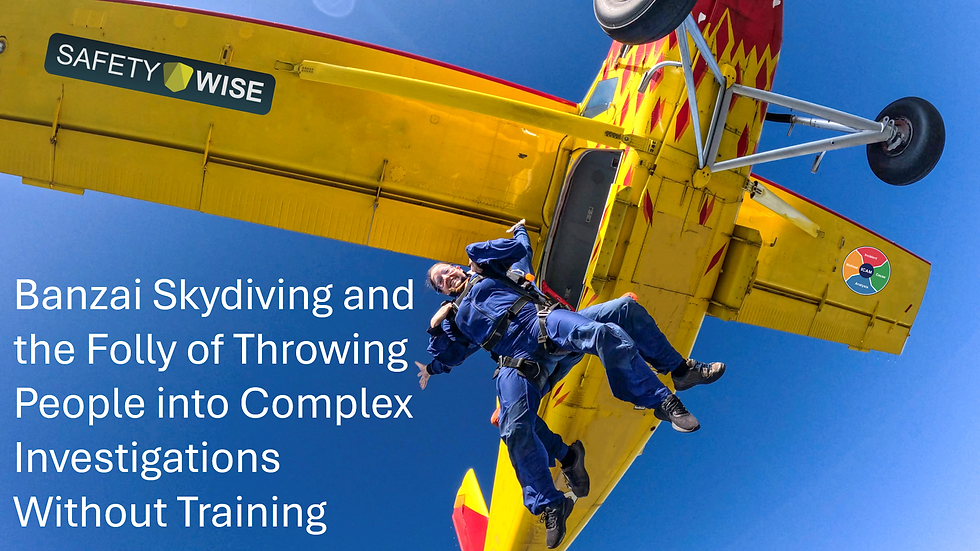
Imagine standing at the open door of an aircraft, parachute in hand. The instructor yells, “Banzai!” and throws your parachute out into the blue void. You’re expected to leap after it, catch it in freefall, strap it on, and pull the cord before the ground rushes up to meet you.
That, in essence, is banzai skydiving- a reckless, almost absurd daredevil stunt where the jumper tosses their parachute away and dives after it. While the “sport” has long been more myth and folklore than a serious pastime, the metaphor it offers is undeniable.
Now take that image and map it onto what many organisations do when a serious workplace incident occurs. A manager, supervisor, or technically competent person is suddenly handed a metaphorical parachute- an “incident investigation” - and shoved out of the plane. They’re expected to chase after it, figure out how to do it mid-air, and somehow land safely with credible findings that satisfy regulators, leadership, and the workforce.
The reality? Many investigations crash spectacularly. And the reason isn’t because people aren’t smart, diligent, or well-intentioned. It’s because organisations insist on throwing people into the equivalent of banzai skydiving investigations, expecting them to succeed in a high-stakes, high-complexity environment without the necessary training, preparation, or tools.
This article explores why that happens, what damage it causes, and why a proper system of training and readiness is as critical for investigations as it is for parachuting.
Part I: The Spectacle of Banzai Skydiving as a Metaphor
What Is Banzai Skydiving?
Banzai skydiving is not a mainstream sport; it’s a dare rooted in bravado. The “rules” are simple: throw your parachute out, count a few seconds, and then jump after it. In most cases, it’s more urban legend than regular practice, but a handful of stunts have been recorded over the years.
It’s not skilful flying per se, not precision canopy control, not calculated performance—it’s chaos. The “athlete” is relying on raw nerve, luck, and just enough skill not to die.
And that’s precisely the point.
Why the Metaphor Works
When a workplace incident happens- a near miss, a chemical release, a fall from height, or worse- organisations often “volunteer” someone to investigate. This person is told:
“You know the site. You’ve been here long enough.”
“You’re the safety rep, so this is your job now.”
“You were the supervisor on duty, so you’re best placed to lead the investigation.”
None of these justifications mean the person is actually trained in investigative techniques, cognitive bias management, evidence preservation, interviewing, root cause analysis frameworks (like ICAM), or report writing.
So the investigation begins like a banzai dive: the investigator chases after the process, assembling methods and confidence in mid-air, while the ground- the regulator’s deadline, management’s expectations, and the workforce’s demand for answers- races up to meet them.
Part II: Why Organisations Throw People Into Investigations Without Training
1. The Myth of “Common Sense”
Organisations often believe investigations are just common sense. “You were there. Just write down what happened.” But incident analysis is not observation- it is structured reasoning. Without training, common sense turns into hindsight bias, oversimplification, and blame.
2. Overconfidence in Technical Expertise
Leaders frequently assume that a technically competent person can naturally investigate. Being a good mechanic, engineer, or nurse doesn’t mean you can reconstruct systemic failures. In fact, technical knowledge can sometimes bias investigators into narrow explanations (“The valve failed because the operator didn’t check it”) rather than systemic ones (“Why did the organisation rely solely on human checks without redundancy?”).
3. Training Seen as a “Nice-to-Have”
In tight budgets, investigation training is often viewed as optional. Organisations might prioritise compliance refreshers or frontline safety inductions, but investigation skills? Those get pushed to the side until an incident forces someone to improvise.
4. The Culture of Urgency
When regulators or executives demand answers now, organisations shortcut preparation. Instead of pausing to assign a trained investigator or bring in external expertise, they throw the nearest person into the role. The result is often a rushed, superficial report that satisfies urgency but fails to uncover meaningful learning.
5. Fear of Acknowledging Complexity
To admit that investigations require specialist skills is to admit that the organisation itself is complex, messy, and fallible. Many leaders prefer the illusion of simplicity: “We’ll just find out what happened and move on.” Training, by contrast, reveals the deeper layers of culture, decision-making, and latent conditions that many organisations would rather avoid.
Part III: The Consequences of Banzai Investigations
1. Superficial Findings
Untrained investigators often default to the simplest explanation: human error. Reports conclude with “The operator should have…” or “The supervisor failed to…” rather than addressing latent conditions like training gaps, resourcing, cultural pressures, or conflicting priorities.
2. Blame and Fear
When reports point fingers, employees lose trust in the process. Instead of encouraging transparency and learning, investigations foster defensiveness and silence. This is like landing from a skydive and blaming the wind for not blowing the parachute closer.
3. Regulatory Risk
Regulators expect investigations to meet certain standards of rigour. Shoddy reports can lead to fines, prosecutions, or enforced undertakings. It’s one thing to jump without a parachute- it’s another to land in a courtroom explaining why you thought it was a good idea.
4. Lost Opportunities for Learning
Every incident contains lessons. A well-run investigation extracts those lessons to strengthen systems. A banzai-style investigation wastes the opportunity, leaving latent conditions in place until the following incident occurs.
5. Burnout and Cynicism
Throwing someone untrained into a high-pressure investigation is stressful. Many never want to do it again. Others become cynical, knowing the process is about ticking boxes rather than real improvement.
Part IV: What Proper Training Looks Like
1. Structured Methodologies
Frameworks like ICAM (Incident Cause Analysis Method) provide a roadmap for investigators. They guide thinking away from blame and towards systemic analysis: organisational factors, task demands, human factors, environmental conditions, and equipment reliability.
2. Skills in Evidence Gathering
Training teaches investigators how to preserve scenes, collect documents, and record interviews without contaminating or biasing evidence. Just as skydivers train endlessly to pack a chute correctly, investigators must drill evidence handling.
3. Understanding Cognitive Bias
Investigations are vulnerable to confirmation bias, hindsight bias, and anchoring. Training helps investigators recognise and manage these biases rather than fall victim to them.
4. Interviewing Techniques
Talking to witnesses is delicate. Without training, questions become leading, defensive, or accusatory. With training, interviews become sources of rich insight into system dynamics.
5. Report Writing for Impact
A well-written report balances technical detail with organisational learning. Training teaches investigators to present findings in a way that leaders can act on, not shelve.
Part V: Moving Beyond Banzai Investigations
1. Building a Cadre of Trained Investigators
Organisations should maintain a pool of trained investigators ready to respond. These people need periodic refreshers, just like pilots maintain their flight hours.
2. Embedding Investigation in Culture
Investigations shouldn’t be emergency improvisations. They should be routine, part of a culture that values learning as much as production.
3. Using External Support When Needed
Not every organisation can maintain deep in-house expertise. Bringing in external professionals, especially for serious incidents, ensures rigour and credibility.
4. Treating Investigations as Opportunities, Not Punishments
Shifting the mindset from “Who stuffed up?” to “What can we learn?” transforms the whole exercise. Training is the enabler of this cultural shift.
Conclusion: From Banzai to Professional Skydiving
No professional skydiver would treat banzai jumping as a sustainable way to practice their craft. It’s a stunt, a curiosity, a guaranteed way to shorten your career.
Yet organisations persist in treating investigations this way- throwing people out the door without parachutes, expecting them to catch the process on the way down, and praying they land without disaster.
The truth is clear: investigations are not stunts. They are structured, disciplined, high-stakes processes that demand training, preparation, and respect.
To continue throwing people into banzai investigations is organisational negligence. To invest in training, frameworks, and culture is to move from reckless daredevilry to professional mastery.
After all, when the ground is rushing up, luck and bravado are no substitute for a properly packed chute.


Comments