
The Terminator vs Cam
Who Would Actually Be Better at an ICAM Investigation?
Most workplace investigations fail for one reason:
They start hunting for who instead of understanding why.
That sounds obvious. But it still happens every day.
An incident occurs. Pressure builds immediately. Operations want answers. Management wants accountability. The workforce wants certainty.
And before long, the investigation becomes a search for:
the mistake
the operator
the breach
the “human error”
the person who caused it.
In other words:
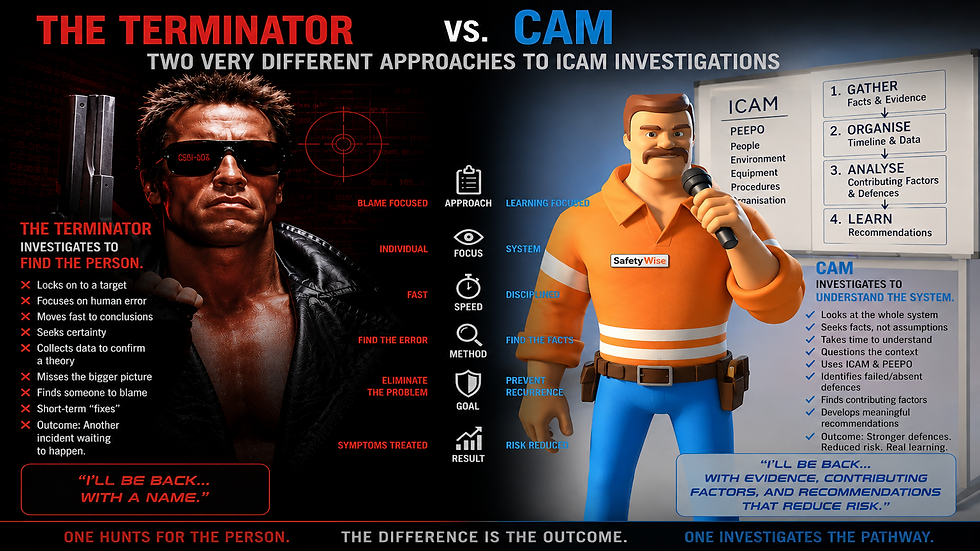
The investigation quietly becomes a Terminator movie.
Find the target. Lock on. Eliminate uncertainty by blaming someone.
But ICAM was never designed for that.
ICAM exists because serious incidents rarely occur because of a single bad decision or one careless worker. The methodology was developed to understand how organisational systems, conditions, controls, decisions, pressures, and defences combine to create the pathway to failure.
And that’s why a character like Cam would probably outperform the Terminator in an ICAM investigation every single time.
Not because Cam is “soft.”
Because good investigations require something far more difficult than aggression:
They require disciplined thinking.
The Terminator Approach to Investigation
The Terminator is incredibly effective at one thing:
Mission focus.
He identifies the target. He gathers data rapidly. He removes obstacles. He pursues a direct causal path with ruthless efficiency.
In a movie, that’s impressive.
In an investigation, it’s dangerous.
Because many investigations unintentionally follow the exact same mindset.
The moment an incident occurs, investigators begin asking:
Who made the error?
Who failed to comply?
Who broke procedure?
Who was responsible?
The pathway becomes linear: Incident → Human Error → Corrective Action.
Done.
Case closed.
The problem is that this style of thinking only treats symptoms.
Safety Wise material repeatedly reinforces that investigations must look beyond the immediate error and identify the broader contributing factors and latent organisational conditions that allowed the event to occur.
The Terminator mindset struggles with that because it naturally:
narrows focus
seeks certainty quickly
locks onto a target
values speed over understanding
treats deviation as the primary issue.
That creates one of the biggest weaknesses in poor investigations:
Premature conclusion bias.
The investigation decides the answer before the evidence is fully understood.
Why “Human Error” Is Usually a Weak Conclusion
One of the strongest principles within ICAM is the recognition that simply identifying “human error” does not prevent recurrence.
The Lead Investigator material explains this clearly: human errors are almost always influenced by wider system conditions and latent organisational factors.
That distinction matters enormously.
Because saying: “The operator made a mistake”
is not an investigation outcome.
It is the beginning of the investigation.
The real questions are:
Why did the mistake make sense at the time?
What conditions existed?
What pressures were present?
What controls were missing or ineffective?
What organisational factors shaped the behaviour?
The Terminator mindset rarely asks those questions.
It sees:
rule broken
procedure not followed
target identified.
But ICAM teaches investigators to understand behaviour in context, not isolation.
That is where Cam becomes the better investigator.
Cam’s Approach: Slow Down Before You Decide
Cam would likely frustrate people early in an investigation.
Because while everyone else is demanding answers, Cam keeps asking:
“What evidence do we actually have?”
“What assumptions are we making?”
“What do we still not understand?”
“What conditions existed before the event?”
“What failed or was absent?”
That sounds slower.
But it is actually more disciplined.
Good investigators understand that speed creates risk.
Especially cognitive risk.
The Data Gathering and Witness Interviewing material reinforces the importance of collecting relevant factual evidence before conclusions are formed.
The investigation process itself follows a structured sequence:
Gather
Organise
Analyse
Learn
Not:
Decide
Confirm
Blame
Close out.
The difference is massive.
Cam would likely spend significant time:
reconstructing timelines
validating witness accounts
identifying failed controls
distinguishing assumptions from evidence
examining work-as-done versus work-as-imagined
exploring organisational influences.
That aligns directly with ICAM methodology.
The Real Problem With “Bad Apple” Thinking
The Terminator approach appeals to organisations because it feels efficient.
If one person caused the problem:
remove the person
retrain the worker
reinforce compliance
close the action.
Simple.
Except it usually solves nothing.
Because incidents are rarely created by a single isolated action.
The ICAM Governance material explains that significant incidents are generally multivariate events involving multiple contributing factors interacting together.
That means:
systems matter
supervision matters
workload matters
design matters
training matters
resource allocation matters
operational pressures matter
organisational culture matters.
If investigators only focus on the worker at the sharp end, the system defects remain untouched.
Which means the organisation learns nothing.
And the next incident pathway is already forming.
The Difference Between Accountability and Blame
One of the biggest misconceptions in modern safety is the belief that system-focused investigation means avoiding accountability.
It doesn’t.
ICAM does not remove personal accountability.
What it removes is simplistic blame.
That distinction is critical.
The Lead Investigator workbook explains that ICAM is not intended to apportion blame but to understand systemic contributing factors and strengthen organisational defences.
Cam would understand this nuance.
The Terminator would not.
The Terminator sees accountability as: “Find the responsible individual.”
Cam sees accountability as: “Understand how the system allowed this outcome to become possible.”
That broader lens creates better learning.
Because strong investigations recognise:
individuals operate within systems
systems shape behaviour
behaviour is influenced by conditions
conditions are influenced by organisational decisions.
This is why Safety Wise consistently positions ICAM as a systems-learning methodology rather than a blame-focused process.
Why Witness Interviews Fail
A Terminator-style investigator would likely conduct terrible witness interviews.
Why?
Because witnesses instantly detect judgement.
The moment an investigator appears to already “know what happened,” witness quality deteriorates.
People:
become defensive
simplify answers
withhold uncertainty
protect themselves
minimise involvement.
Good interviewing requires neutrality.
The Data Gathering and Witness Interviewing workbook stresses the importance of gathering accurate, relevant, and reliable information while reassuring interviewees that the process exists to prevent recurrence — not apportion blame.
Cam would likely:
listen longer
interrupt less
clarify assumptions
separate fact from interpretation
allow uncertainty to remain visible.
That creates psychologically safer conversations.
And psychologically safer conversations produce better evidence.
The Importance of PEEPO Thinking
One of the strongest aspects of ICAM investigations is the use of structured data gathering categories through PEEPO:
People
Environment
Equipment
Procedures
Organisation.
The Terminator mindset struggles with PEEPO because it naturally prioritises People above everything else.
But ICAM deliberately widens the lens.
Cam would likely move systematically through all categories:
What environmental conditions existed?
What equipment conditions contributed?
Were procedures workable?
What organisational influences existed?
Were there conflicting priorities?
Were there latent system weaknesses?
That broader perspective changes investigation quality dramatically.
Because incidents rarely emerge from one isolated point of failure.
They emerge from interacting weaknesses.
Failed Defences Matter More Than Individual Mistakes
One of the most powerful ICAM concepts is the idea of Absent or Failed Defences.
This comes directly from the Reason Model foundations underpinning ICAM.
The question becomes: “What barriers should have prevented this event?”
Not: “Who failed?”
That shift matters enormously.
Because organisations with mature investigation capability understand: people are the final line of defence within systems.
If one human action can create catastrophe, the system is already fragile.
The Terminator focuses on the final action.
Cam investigates the failed layers behind it.
That is far more useful.
Why Organisations Prefer the Terminator
Ironically, many organisations unintentionally reward Terminator investigations.
Why?
Because they:
finish quickly
produce certainty
reduce ambiguity
appear decisive
satisfy emotional pressure.
A simple narrative is attractive.
Especially after serious incidents.
But simple narratives are often wrong.
High-quality investigations are uncomfortable because they reveal complexity:
competing priorities
tolerated drift
production pressures
resource limitations
weak supervision
design compromises
cultural problems.
Those findings are harder to manage than: “operator failed to follow procedure.”
But they are also where the real learning exists.
Cam Understands That Procedures Are Not Reality
One of the most important distinctions in modern investigations is: work-as-imagined versus work-as-done.
The official procedure often describes idealised work.
Actual operational work is usually messier:
changing conditions
conflicting demands
time pressure
incomplete information
operational variability.
The Data Gathering material specifically highlights the need to assess formal versus informal work practices.
The Terminator would likely ask: “Was the procedure followed?”
Cam would ask: “Was the procedure realistic?”
That second question is far more valuable.
Because organisations often drift into normalised deviation long before incidents occur.
The Real Goal of Investigation
Poor investigations seek closure.
Good investigations seek learning.
That difference changes everything.
The primary objective of ICAM is to strengthen organisational defences and prevent recurrence through understanding contributing factors and system weaknesses.
That means investigations are not simply administrative exercises.
They are opportunities to:
identify risk pathways
improve controls
strengthen systems
improve operational resilience
reduce future exposure.
The Terminator treats investigations as target acquisition.
Cam treats investigations as organisational learning.
Only one of those improves safety long term.
So Who Would Be Better at ICAM?
The Terminator would probably:
secure the scene effectively
gather massive amounts of data quickly
intimidate witnesses
identify procedural breaches rapidly
produce a fast report.
But the investigation would likely:
oversimplify the event
over-focus on human error
miss latent conditions
ignore system interactions
create weak learning outcomes.
Cam would probably:
move slower initially
ask harder questions
tolerate uncertainty longer
challenge assumptions
explore context deeply
identify failed controls and organisational contributors.
And that is exactly what ICAM requires.
Because ICAM is not about identifying the villain.
It is about understanding the system.
The best investigators are not the most aggressive.
They are the most disciplined thinkers.
They resist premature conclusions. They separate evidence from assumption. They understand human performance in context. They examine systems, controls, pressures, and conditions. They focus on learning instead of blame.
The Terminator hunts for the person.
Cam investigates the pathway.
And in ICAM, the pathway is where the real answers are found.


Comments